Before choosing a diet, choose the question
A reading map connecting weight, food quality, glucose measurements and maintenance—with a fair way to compare popular diets.
6 source recordsRead the lesson
A LEARNING PATH
Which diet question are you really asking?
Separate weight, glucose, food structure and adherence before comparing diets.
All lessons in this topic are free to read without signing in.
STAGE 01 · 4 QUESTIONS
After reading, try this: Separate weight change from cardiovascular outcomes before ranking a diet.
Compare two dietary strategies without confusing their names, achieved intake, or average results with a personal prediction.
Free lesson 4 min · full lessonSeparate fuel selection, food intake, body weight, and body-fat change before judging a ketogenic-diet claim.
Free lesson 3 min · full lessonRead a dietary-pattern trial without turning it into a claim for one premium ingredient.
Free lesson 4 min · full lessonUse a clearly labeled example week to practice a DASH-style pattern, compare sodium sources and distinguish a food-group guide from a personalized meal prescription.
Free lesson 5 min · full lessonSTAGE 02 · 4 QUESTIONS
After reading, try this: Use an equal amount of two fictional foods to compare their label values.
Use two fictional cereal labels to compare portions, sodium, added sugars and fiber without turning one nutrient into a health score.
Free lesson 5 min · full lessonUse a controlled feeding experiment to distinguish a causal menu effect from a claim about every packaged food.
Free lesson 3 min · full lessonCompare long-term diet evidence, short-term trials, and microbiome markers without treating them as interchangeable.
Free lesson 3 min · full lessonSeparate a macronutrient target, an achieved diet, and the additional value of a strategy over time.
Free lesson 3 min · full lessonSTAGE 03 · 4 QUESTIONS
After reading, try this: Explain why a short glucose curve cannot stand in for every metabolic outcome.
Use the comparator to distinguish a convenient routine from a proven additional effect.
Free lesson 3 min · full lessonExplore a small proof-of-concept experiment and why an interesting mechanism is not a universal meal schedule.
Free lesson 3 min · full lessonCompare fasting plasma glucose, A1C, an oral glucose tolerance test and continuous monitoring by what they measure, when they measure it and what can distort the result.
Free lesson 4 min · full lessonSeparate prediction of a meal response from proof of better long-term health.
Free lesson 3 min · full lessonSTAGE 04 · 4 QUESTIONS
After reading, try this: Write one question about maintenance or comparison that a headline leaves out.
Maintenance is an ongoing task involving appetite, a changed energy requirement, repeatable meals, support and plans for interruptions. A fictional workweek shows how to make the task concrete.
Free lesson 5 min · full lessonUnderstand what changed in a small dietary experiment and why microbial diversity is not a clinical cure.
Free lesson 3 min · full lessonSeparate sugar replacement, long-term weight-control guidance, observational associations, and toxicology.
Free lesson 3 min · full lessonRead a large pragmatic trial, including its event-rate denominator and the limits of potassium-containing substitutes.
Free lesson 3 min · full lessonONE STUDY, IN CONTEXT
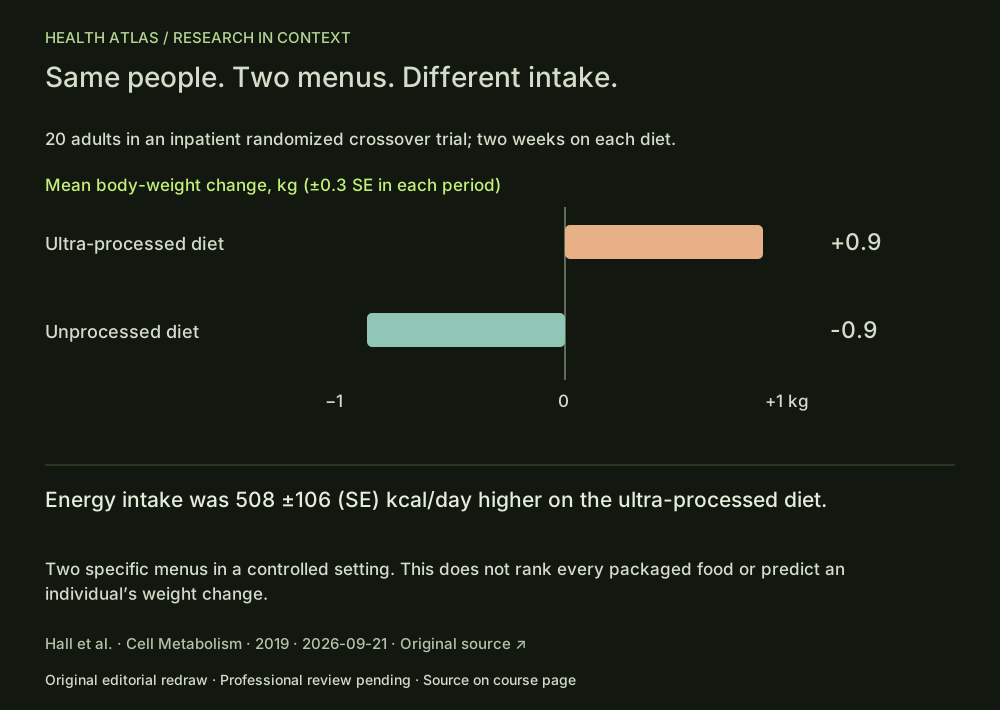
20 adults in an inpatient randomized crossover trial; two weeks on each diet.
Mean body-weight change, kg (±0.3 SE in each period)
Average weight gain
Average weight loss
Energy intake was 508 ±106 (SE) kcal/day higher on the ultra-processed diet.
Two specific menus in a controlled setting. This does not rank every packaged food or predict an individual’s weight change.
Hall et al. · Cell Metabolism · 2019 · 2026-09-21Original editorial redraw · Professional review pending
20 adults in an inpatient randomized crossover trial; two weeks on each diet.
Mean body-weight change, kg (±0.3 SE in each period)
Energy intake was 508 ±106 (SE) kcal/day higher on the ultra-processed diet.
Two specific menus in a controlled setting. This does not rank every packaged food or predict an individual’s weight change.
PubMed abstract and figure descriptions read; not a full-paper review.
Hall et al. · Cell Metabolism · 2019A reading map connecting weight, food quality, glucose measurements and maintenance—with a fair way to compare popular diets.
Explore creators’ ideas in their original context. These media links are not the scientific evidence for this course.
Official video and transcript; describes her communication framework.