What would count as evidence for a supplement?
Connect deficiency, performance, disease prevention, formulation and interactions before turning a promising ingredient into a shopping decision.
8 source recordsRead the lesson
A LEARNING PATH
For whom, for which outcome, compared with what?

Understand ingredients, deficiency, trial populations and uncertainty without a shopping stack.
All lessons in this topic are free to read without signing in.
STAGE 01 · 2 QUESTIONS
After reading, try this: Distinguish an ingredient, a serving, a product claim and an interaction question.
Three different bottles can contain the same nutrient. Work through invented vitamin D and magnesium labels to separate arithmetic, reference values and the decision about whether a product is useful.
Free lesson 5 min · full lessonUse vitamin K, magnesium, St. John’s wort and biotin to distinguish several mechanisms. Learn what information makes a pharmacist’s review possible without turning the examples into a self-directed medicine schedule.
Free lesson 4 min · full lessonSTAGE 02 · 5 QUESTIONS
After reading, try this: Explain why correcting a deficiency and preventing disease are different questions.
Vitamin D is necessary for bone mineralization, but necessity does not mean that adding more prevents fractures in every population.
Free lesson 2 min · full lessonCompare vitamin D biology, blood measurements and disease prevention without treating them as interchangeable outcomes.
Free lesson 2 min · full lessonCalcium adequacy, absorption, bone density and fracture prevention are connected questions with different evidence requirements.
Free lesson 3 min · full lessonIron stores, anemia and fatigue are related but nonidentical concepts; testing the cause matters more than choosing an energy supplement.
Free lesson 2 min · full lessonB12 needs both a reliable source and a functioning absorption pathway. Plant-based diets, stomach changes and some medicines affect different parts of that pathway.
Free lesson 3 min · full lessonSTAGE 03 · 4 QUESTIONS
After reading, try this: Keep the training conditions, study population and intended outcome together.
Understand the short-burst energy system before comparing creatine with protein powders, stimulants or endurance fuel.
Free lesson 3 min · full lessonA small laboratory experiment raises an interesting brain-energy question without establishing a sleep-replacement strategy.
Free lesson 2 min · full lessonThe useful comparison is training with versus without additional protein, while accounting for the protein already supplied by food.
Free lesson 2 min · full lessonSeparate magnesium’s essential biology from the limited clinical evidence for insomnia and claims about premium supplement forms.
Free lesson 2 min · full lessonSTAGE 04 · 5 QUESTIONS
After reading, try this: Explain why evidence for one formulation or strain does not transfer automatically.
Learn why omega-3 biology, eating fish and taking a capsule are related but distinct questions.
Free lesson 2 min · full lessonThe formulation, enrolled risk group and background treatment define the intervention more precisely than the phrase omega-3.
Free lesson 2 min · full lessonA probiotic is not one uniform ingredient. Learn to identify the organism, formulation and clinical purpose.
Free lesson 2 min · full lessonThis is a specific prevention question with stronger evidence than a general promise to improve the microbiome.
Free lesson 2 min · full lessonCOSMOS reported small cognitive-test benefits; the age-equivalent headline is a model translation, not a measured reversal of aging.
Free lesson 2 min · full lessonONE STUDY, IN CONTEXT
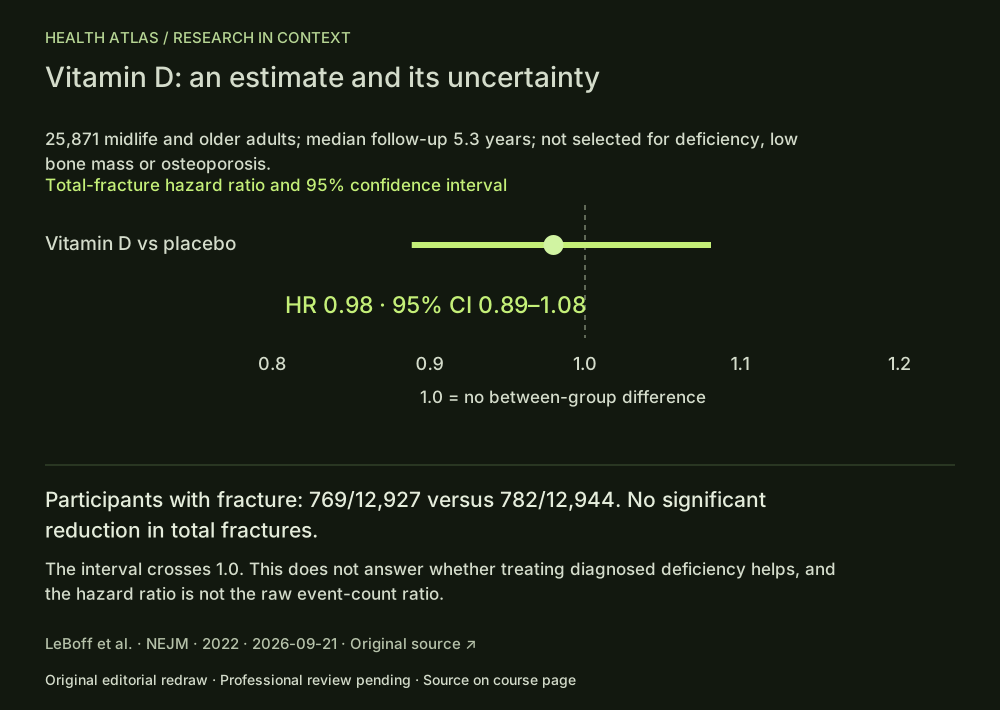
25,871 midlife and older adults; median follow-up 5.3 years; not selected for deficiency, low bone mass or osteoporosis.
Total-fracture hazard ratio and 95% confidence interval
HR 0.98 · 95% CI 0.89–1.08
1.0 = no between-group difference
Participants with fracture: 769/12,927 versus 782/12,944. No significant reduction in total fractures.
The interval crosses 1.0. This does not answer whether treating diagnosed deficiency helps, and the hazard ratio is not the raw event-count ratio.
LeBoff et al. · NEJM · 2022 · 2026-09-21Original editorial redraw · Professional review pending
25,871 midlife and older adults; median follow-up 5.3 years; not selected for deficiency, low bone mass or osteoporosis.
Total-fracture hazard ratio and 95% confidence interval
Participants with fracture: 769/12,927 versus 782/12,944. No significant reduction in total fractures.
The interval crosses 1.0. This does not answer whether treating diagnosed deficiency helps, and the hazard ratio is not the raw event-count ratio.
Original-paper abstract/results via search index; direct page returned no body.
LeBoff et al. · NEJM · 2022Connect deficiency, performance, disease prevention, formulation and interactions before turning a promising ingredient into a shopping decision.
Explore creators’ ideas in their original context. These media links are not the scientific evidence for this course.
Original episode and transcript; distinguishes behavior, nutrition and supplementation.
2025-03-31 interview. Attribute specialist explanations to Candow, not automatically to Patrick.