Before choosing a diet, choose the question
A reading map connecting weight, food quality, glucose measurements and maintenance—with a fair way to compare popular diets.
6 source recordsRead the lesson
A LEARNING PATH
What is the smallest useful starting point?

Compare time, effort, movement skills and the outcome a study actually measured.
The directory distinguishes free lessons from the 12 Strength Foundations previews. Preview lessons include the first chapter; the remaining chapters, self-checks and complete notes are part of the US$4.99 one-time pack.
Explore Strength FoundationsSTAGE 01 · 5 QUESTIONS
After reading, try this: Explain how a starting dose differs from a weekly guideline and a study result.
A practical map of short exercise: the hard work, recovery time, physiological adaptation and what still needs separate practice.
Free lesson 3 min · full lessonMake sense of 150 moderate minutes, 75 vigorous minutes and two strength days—without treating the weekly guideline as a first-day workout.
Free lesson 3 min · full lessonCompare the CDC talk test, a threshold-based Zone 2 definition and watch heart-rate bands; learn what each can and cannot tell you.
Free lesson 3 min · full lessonCompare work and recovery, time demands, fitness outcomes and long-term mortality evidence.
Free lesson 3 min · full lessonUnderstand the dose-response curve, age differences, cadence and what a step counter misses.
Free lesson 3 min · full lessonSTAGE 02 · 9 QUESTIONS
After reading, try this: Compare an easier version with a progression; identify what should stay controlled.
A movement lesson in foot support, coordinated knee and hip bending, controlled depth and useful variations.
Strength pack · preview 4 min · full lessonUnderstand the hinge used in good mornings, deadlift patterns and the setup of a bent row.
Strength pack · preview 4 min · full lessonLearn setup, coordinated lowering, pressing, breathing and how wall or incline versions change the task.
Strength pack · preview 4 min · full lessonCompare a supported seated row with a bent row and learn the setup, pull, return and common compensations.
Strength pack · preview 4 min · full lessonLearn the floor setup, rise, breathing and return; distinguish a controlled bridge from chasing height.
Strength pack · preview 5 min · full lessonLearn why a farmer carry and a suitcase carry are different tasks, and how to keep the walking path controlled.
Free lesson 3 min · full lessonLearn supported standing, heel-to-toe walking and step-ups, with clear distinctions between skill teaching and fall-prevention evidence.
Free lesson 3 min · full lessonBuild a warm-up from gradual movement and rehearsal, and understand what performance studies can establish.
Free lesson 3 min · full lessonLearn why strength and range of motion can develop together, and why more range is not always the immediate goal.
Free lesson 3 min · full lessonSTAGE 03 · 10 QUESTIONS
After reading, try this: Build a fictional session on paper: state its priority, time cost and tradeoffs.
Separate repetitions, sets, load and weekly volume to understand efficient strength training.
Free lesson 3 min · full lessonLearn the difference between muscular effort, technical breakdown and an unsuccessful repetition.
Strength pack · preview 3 min · full lessonLearn how load, range, repetitions and support change a resistance exercise, using actual loading trials.
Free lesson 3 min · full lessonCompare short and longer rests, then count the time and work in a complete fictional session.
Strength pack · preview 5 min · full lessonSeparate exercise order from warm-up, supersets and weekly scheduling, using concrete session comparisons.
Strength pack · preview 5 min · full lessonSeparate movement support, strength-test specificity and muscle-size change before judging equipment.
Strength pack · preview 5 min · full lessonFollow where recovery moves when exercises are paired, and compare time savings with completed work and effort.
Strength pack · preview 5 min · full lessonLearn what changes when weekly resistance work is distributed across muscles or sessions, and what equal-volume evidence finds.
Strength pack · preview 3 min · full lessonSeparate muscle size, maximal strength and explosive performance when discussing interference.
Strength pack · preview 3 min · full lessonConnect muscle repair, total food intake, supplementation trials and the limits of the famous 1.6 g/kg figure.
Free lesson 3 min · full lessonSTAGE 04 · 8 QUESTIONS
After reading, try this: Distinguish a practical opportunity from proof of long-term disease prevention.
Compare vigorous stair bouts with everyday movement breaks and separate fitness from fat oxidation.
Free lesson 3 min · full lessonCompare two acute walking-break experiments and understand why results differ between populations.
Free lesson 3 min · full lessonUse a route, feedback and a modest plan to connect research on adherence with everyday activity.
Free lesson 3 min · full lessonUnderstand what accelerometer cohorts say about concentrating activity, and what they cannot say about injury or ideal scheduling.
Free lesson 3 min · full lessonSeparate delayed soreness from effort during exercise, and flexibility from recovery claims.
Free lesson 3 min · full lessonCompare soreness outcomes with long-term strength adaptations before treating ice baths as a default.
Free lesson 3 min · full lessonUnderstand static muscle work, the difference between resting and exercising blood pressure, and why rankings do not replace treatment.
Free lesson 3 min · full lessonUnderstand combined heat load, practical cooling choices, acclimatization and clear stop signs.
Free lesson 5 min · full lessonONE STUDY, IN CONTEXT
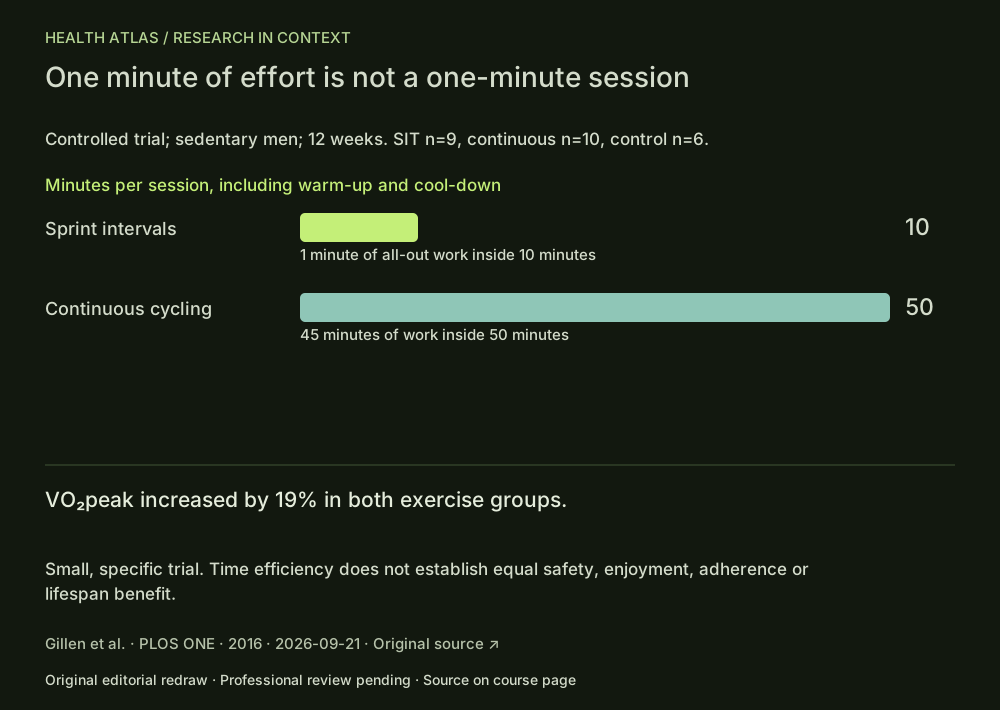
Controlled trial; sedentary men; 12 weeks. SIT n=9, continuous n=10, control n=6.
Minutes per session, including warm-up and cool-down
VO₂peak increased by 19% in both exercise groups.
Small, specific trial. Time efficiency does not establish equal safety, enjoyment, adherence or lifespan benefit.
Gillen et al. · PLOS ONE · 2016 · 2026-09-21Original editorial redraw · Professional review pending
Controlled trial; sedentary men; 12 weeks. SIT n=9, continuous n=10, control n=6.
Minutes per session, including warm-up and cool-down
VO₂peak increased by 19% in both exercise groups.
Small, specific trial. Time efficiency does not establish equal safety, enjoyment, adherence or lifespan benefit.
Publisher abstract and relevant methods/results read.
Gillen et al. · PLOS ONE · 2016BUILD AN EXAMPLE WEEK
Change this fictional example to see how mixed-intensity minutes add up. It does not assess your health or calculate fat loss or lifespan benefits.
90 + 2 × 30 = 150 moderate-equivalent minutes / week
Aerobic example reaches the 150-minute reference; the strength example is 1 day and remains a separate component.
Adult public-health reference: at least 150 moderate or 75 vigorous aerobic minutes, or an equivalent combination, plus muscle strengthening involving the major muscle groups on at least two days. Activity below the reference can help; the reference is not a benefit ceiling. This example only explains counting. It cannot check intensity, muscle-group coverage or individual suitability.
CDC original adult activity guidanceA reading map connecting weight, food quality, glucose measurements and maintenance—with a fair way to compare popular diets.
A map from everyday function to prevention and experimental ageing markers, with mobility and aspirin trials showing why the outcome matters.
Explore creators’ ideas in their original context. These media links are not the scientific evidence for this course.
Primary episode, 2022-05-09. Public summary and timestamps; extended notes require membership.
Official episode with links to studies; marketing language is not adopted as clinical proof.