Why “sleep better” needs more than one question
Connect sleep opportunity, body-clock timing, persistent insomnia, breathing symptoms and wearable measurements without turning a checklist into a diagnosis.
10 source recordsRead the lesson
A LEARNING PATH
What does feeling better actually mean in a study?

Compare breathing, attention, movement and connection while preserving treatment boundaries.
All lessons in this topic are free to read without signing in.
STAGE 01 · 4 QUESTIONS
After reading, try this: Distinguish a reaction, a screening result, a work problem and a diagnosis.
A racing mind can reflect an immediate demand, persistent apprehension, or several overlapping problems. Learn to connect triggers, bodily arousal, avoidance and daily function without self-diagnosing.
Free lesson 4 min · full lessonA questionnaire can make symptoms easier to communicate. Its strengths become clearer when screening accuracy, functional impact and professional assessment are kept separate.
Free lesson 4 min · full lessonThe occupational meaning of burnout points toward workload, control and support. Compare individual coping with changes to work itself, using a concrete team example.
Free lesson 4 min · full lessonA therapist, a skills app and a peer group can all be useful while providing different services. Learn the questions that reveal qualifications, methods, support, privacy and progress.
Free lesson 4 min · full lessonSTAGE 02 · 5 QUESTIONS
After reading, try this: Identify the comparison group and measured outcome before recommending a method.
Breathing pace can influence bodily arousal. A short randomized study makes the idea interesting, while also showing why a calmer moment and treatment of an anxiety disorder are different outcomes.
Free lesson 3 min · full lessonWalking, strength work and yoga appear in randomized depression research. The useful question is how activity fits daily function and established care, rather than whether one workout can erase a diagnosis.
Free lesson 3 min · full lessonAn anxiety trial compared a structured eight-week mindfulness program with medication. Its result is more informative when the program, time commitment and clinical outcome remain visible.
Free lesson 3 min · full lessonEmotion labeling is a small, specific skill. Laboratory studies measured both brain responses and reported distress, showing a possible role for naming without turning it into a guaranteed emotional switch.
Free lesson 3 min · full lessonResearch on accepting emotions includes both prospective associations and laboratory experiments with mixed findings. Context helps explain why “never suppress” is too simple a rule.
Free lesson 3 min · full lessonSTAGE 03 · 4 QUESTIONS
After reading, try this: Map the people, services and surroundings involved in a fictional situation.
Loneliness, isolation and dependable support describe different things. Research connects social life with health, while a telephone trial offers a concrete example of a modest intervention.
Free lesson 3 min · full lessonCare includes coordination, transport, meals, companionship and backup arrangements. Make the hidden work visible while keeping the person receiving care involved in decisions.
Free lesson 4 min · full lessonA small experiment compared nature and urban walks, measuring both repetitive negative thinking and a brain signal. It offers a specific clue about environment, without establishing a mandatory dose of forest time.
Free lesson 3 min · full lessonA randomized Facebook deactivation study found benefits and tradeoffs. Its most useful lesson is to examine what an online activity supplies and what replaces it when it stops.
Free lesson 3 min · full lessonSTAGE 04 · 2 QUESTIONS
After reading, try this: Explain the difference between noticing an experience and expecting a guaranteed change.
Gratitude experiments studied a small shift in attention toward appreciated events. Their findings were selective, which makes the practice more realistic than claims of a universal happiness cure.
Free lesson 3 min · full lessonA repeatable situation can make an action easier to begin. Separate automaticity from a perfect streak, a creator’s program length and the health benefit of the action itself.
Free lesson 4 min · full lessonONE STUDY, IN CONTEXT
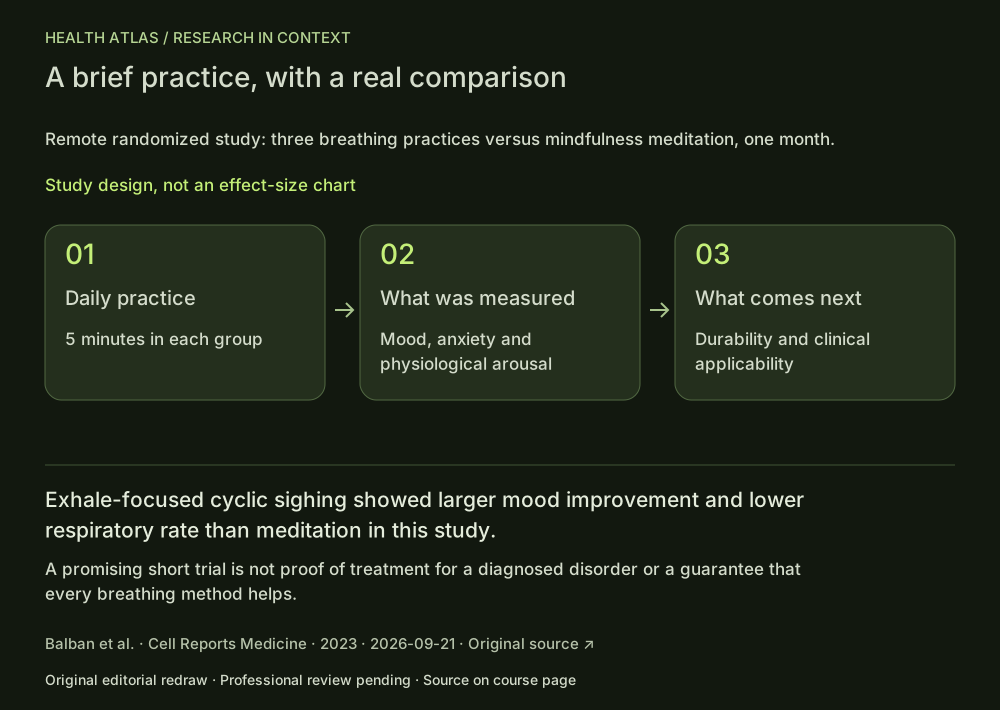
Remote randomized study: three breathing practices versus mindfulness meditation, one month.
Study design, not an effect-size chart
5 minutes in each group
Mood, anxiety and physiological arousal
Durability and clinical applicability
Exhale-focused cyclic sighing showed larger mood improvement and lower respiratory rate than meditation in this study.
A promising short trial is not proof of treatment for a diagnosed disorder or a guarantee that every breathing method helps.
Balban et al. · Cell Reports Medicine · 2023 · 2026-09-21Original editorial redraw · Professional review pending
Remote randomized study: three breathing practices versus mindfulness meditation, one month.
Study design, not an effect-size chart
Exhale-focused cyclic sighing showed larger mood improvement and lower respiratory rate than meditation in this study.
A promising short trial is not proof of treatment for a diagnosed disorder or a guarantee that every breathing method helps.
PubMed abstract and figure descriptions read.
Balban et al. · Cell Reports Medicine · 2023Connect sleep opportunity, body-clock timing, persistent insomnia, breathing symptoms and wearable measurements without turning a checklist into a diagnosis.
A map from everyday function to prevention and experimental ageing markers, with mobility and aspirin trials showing why the outcome matters.
Explore creators’ ideas in their original context. These media links are not the scientific evidence for this course.
Episode published 2023-02-20; includes discussion of a human breathwork study.
Original episode and notes, 2025-05-30.