Why “sleep better” needs more than one question
Connect sleep opportunity, body-clock timing, persistent insomnia, breathing symptoms and wearable measurements without turning a checklist into a diagnosis.
10 source recordsRead the lesson
A LEARNING PATH
What can a sleep habit or tracker tell you?
Read sleep duration, timing, light and measurement without reducing sleep to a score.
All lessons in this topic are free to read without signing in.
STAGE 01 · 4 QUESTIONS
After reading, try this: Explain duration, timing and learning as related but distinct ideas.
Why regular six-hour nights fall below adult recommendations, why eight is not an exact rule, and how time in bed differs from sleep.
Free lesson 2 min · full lessonClock time, biological timing and the available sleep window are related but distinct.
Free lesson 3 min · full lessonA large cohort can identify a predictor without proving that one habit replaces another.
Free lesson 3 min · full lessonDistinguish learning, retaining and retrieving information before interpreting a sleep claim.
Free lesson 3 min · full lessonSTAGE 02 · 3 QUESTIONS
After reading, try this: Read an experiment with its exposure, dose and study population attached.
Screen light, stimulating content and delayed bedtime are separate questions that a good comparison keeps visible.
Free lesson 3 min · full lessonTiming matters, but an experimental exposure does not define everybody’s personal cutoff.
Free lesson 2 min · full lessonFalling asleep, sleep-stage timing and next-day function are separate outcomes. Alcohol research shows why an apparently helpful bedtime effect can coexist with a disrupted night.
Free lesson 3 min · full lessonSTAGE 03 · 4 QUESTIONS
After reading, try this: Compare a nap, a weekend recovery period, a night shift and a flight.
Nap duration changes the timing of benefit, and time in bed is not identical to time asleep. A small laboratory comparison helps explain why a longer nap is not always better for an immediate task.
Free lesson 3 min · full lessonRecovery can affect one outcome without fully reversing every consequence of repeated restriction.
Free lesson 3 min · full lessonSeparate biological timing, time available for sleep, and the demands of work. A useful shift-work plan includes the commute and the household, not only the bedroom.
Free lesson 4 min · full lessonTravel fatigue and circadian misalignment overlap, but they are different problems. Direction, time-zone change and trip length help explain why a universal morning-light rule is incomplete.
Free lesson 4 min · full lessonSTAGE 04 · 3 QUESTIONS
After reading, try this: Describe the limits of a tracker and how insomnia and breathing concerns differ.
Separate a sensor signal, an algorithm’s estimate and a clinical interpretation.
Free lesson 3 min · full lessonCompare a clinical treatment package with general habits without turning either into a do-it-yourself prescription.
Free lesson 4 min · full lessonLearn the boundary between a symptom description, consumer feedback and a diagnostic assessment.
Free lesson 4 min · full lessonONE STUDY, IN CONTEXT
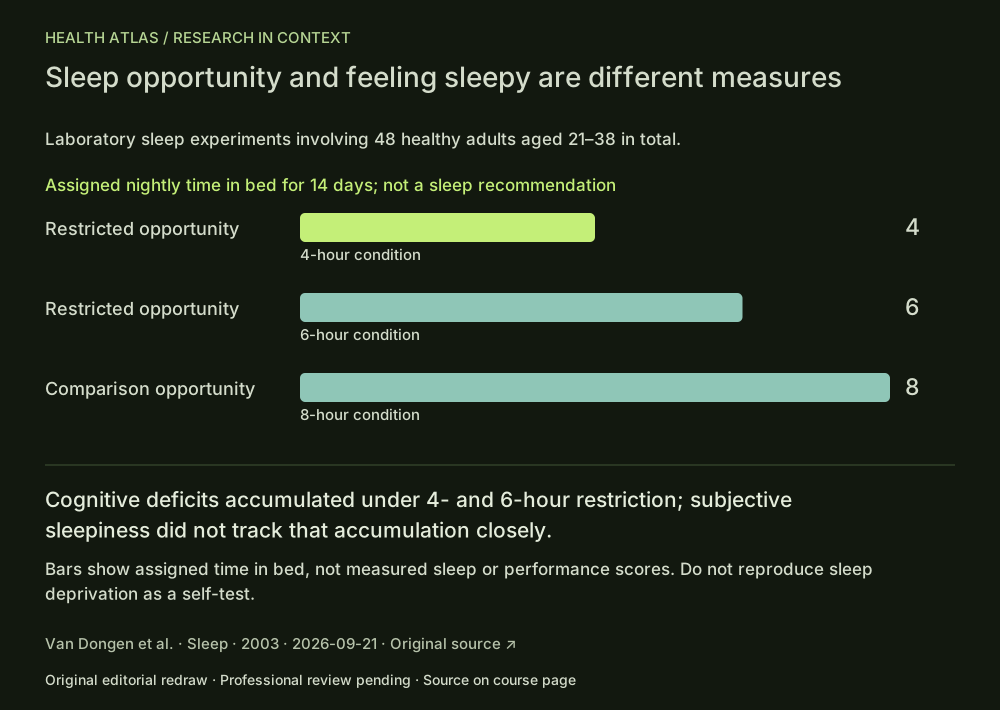
Laboratory sleep experiments involving 48 healthy adults aged 21–38 in total.
Assigned nightly time in bed for 14 days; not a sleep recommendation
Cognitive deficits accumulated under 4- and 6-hour restriction; subjective sleepiness did not track that accumulation closely.
Bars show assigned time in bed, not measured sleep or performance scores. Do not reproduce sleep deprivation as a self-test.
Van Dongen et al. · Sleep · 2003 · 2026-09-21Original editorial redraw · Professional review pending
Laboratory sleep experiments involving 48 healthy adults aged 21–38 in total.
Assigned nightly time in bed for 14 days; not a sleep recommendation
Cognitive deficits accumulated under 4- and 6-hour restriction; subjective sleepiness did not track that accumulation closely.
Bars show assigned time in bed, not measured sleep or performance scores. Do not reproduce sleep deprivation as a self-test.
Original-paper abstract via search index; direct page returned no body.
Van Dongen et al. · Sleep · 2003Connect sleep opportunity, body-clock timing, persistent insomnia, breathing symptoms and wearable measurements without turning a checklist into a diagnosis.
Explore creators’ ideas in their original context. These media links are not the scientific evidence for this course.
Official channel linked from Huberman Lab.
A channel entry, not a selected or fully reviewed video.